Put the rug under the cricket.
Jaipur Rugs sells handknotted carpets made by weavers across Rajasthan, Gujarat and Bihar. A serious piece is a five-figure decision at least, often six. The category has one obvious place to advertise, and everyone in it advertises there: the design press, the design fairs, the design internet.
Which is precisely the problem. A rug advertisement inside Architectural Digest is surrounded by other rug advertisements. The reader is in shopping mode, comparing, and the brand becomes one option in a set. You pay a premium to be commoditised.
So the plan I wrote argued for the opposite. Buy live cricket.
The most contextually perfect frame for cricket on a carpet is live cricket.
The campaign creative was cricket played on a Jaipur rug, fronted by Harmanpreet Kaur. Once that idea existed, the media buy stopped being a targeting exercise and became a placement one. The most contextually perfect frame for an ad about cricket on a carpet is a live cricket match, and the Women’s World Cup was about to be broadcast to the largest sports audience in the country.
The numbers helped the argument. Streamed cricket holds a viewer for roughly half an hour; a social feed holds one for five seconds. Contextual placements during a match recall markedly better than standard display. Women’s World Cup viewership was growing at over thirty percent a year, which meant buying an audience on the way up rather than one already priced in.
But the real reason was simpler. In a design magazine, Jaipur Rugs is a rug brand among rug brands. During a cricket match, it is the only rug in the room.
Everyone in the category was buying the same audience. Nobody was buying the same moment.
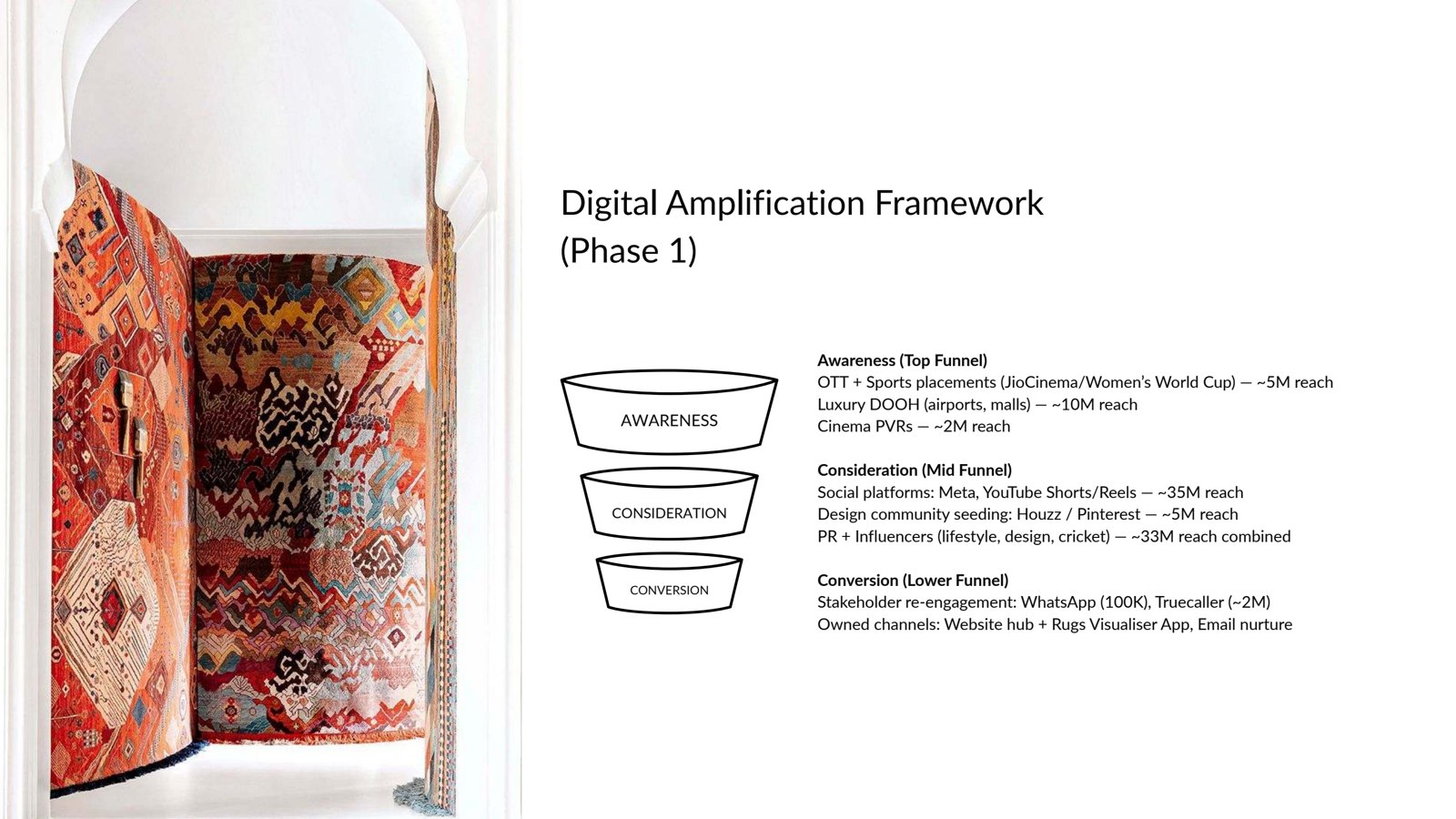
The rest of the plan follows from that. Luxury out-of-home at airports and malls, cinema, design platforms like Pinterest and Houzz for the people actively renovating, and a tiered influencer structure that separated lifestyle creators from practising architects, because those two groups are persuaded by completely different things. The architect wants specification and reliability. The couple furnishing their first good apartment wants to see it in their own living room, which is why the second phase is an augmented-reality visualiser rather than more advertising.
Reach is a comfortable number. It tells you almost nothing.
The section I would actually defend in a room is the one nobody enjoys writing. The earlier plan had spread across fifteen or more touchpoints and measured itself on reach. Reach is a comfortable number. It goes up, it is easy to report, and it tells you almost nothing.
The revision cut the plan to five or six channels and replaced the reach targets with store bookings, cart-to-purchase rate and e-commerce return on spend. Fewer places, measured harder. That is a less impressive slide and a better plan, and the two are related more often than anyone admits.
Craft does not need a craft audience.
Heritage brands tend to advertise where heritage is already appreciated, and then wonder why growth is slow. The audience there is finite and has already made up its mind. Growth lives one step sideways, in a place where nobody is selling what you sell and the brand arrives as a surprise rather than as a comparison.
Craft does not need a craft audience. It needs a large one, caught at a moment when it happens to be looking.
Nineteen slides: audience sizing, persona architecture, the channel split, phase two conversion tooling and the measurement model. Shared as submitted, with commercial terms removed.
Prerna Gautam is a brand and creative strategist working across luxury, lifestyle and wellness. Strategy Notes publishes the thinking behind the work, including the parts that did not survive the room.
Written as a pitch for Rug Utsav, Jaipur Rugs’ annual carpet sale, in collaboration with Markethink. Reach and audience figures are as cited in the deck, sourced from Google Reach Planner and published platform data. Budget detail and commercial terms are not reproduced here.