The New CEO of Vaseline
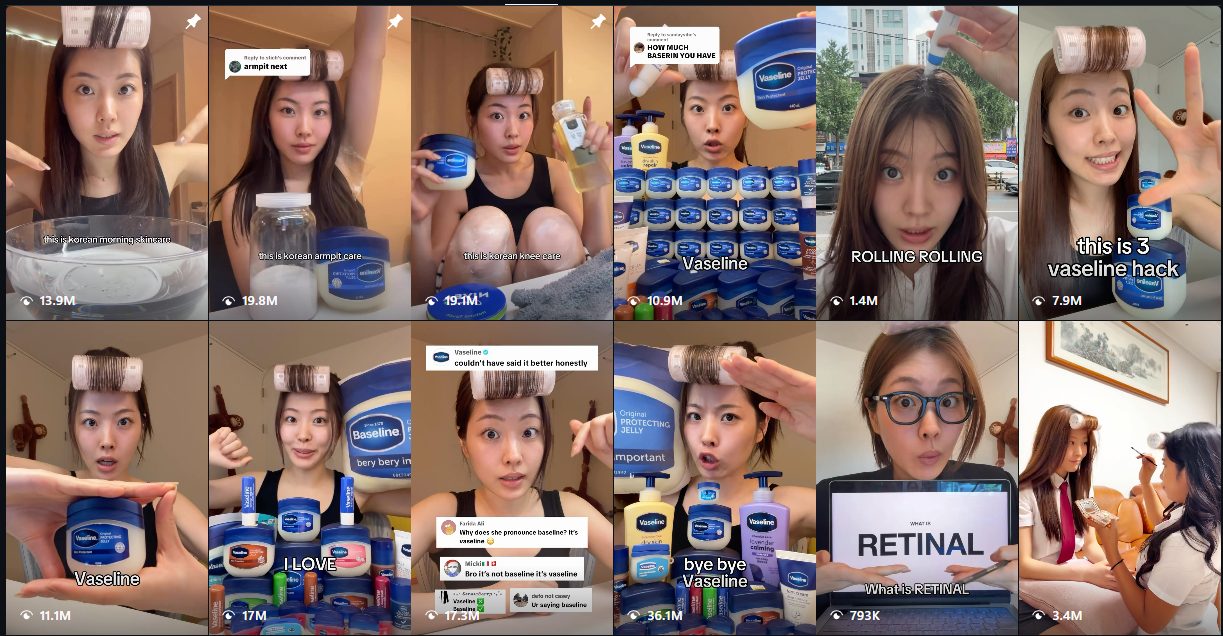
She arrived on my feed the way these things always do, which is to say without permission and slightly too often.
A Korean woman with a hair roller sitting on her fringe, a wall of blue tubs behind her, telling me to dab my face. Tok tok. Always tok tok. By the fourth video I was saying it in my head while doing my own skincare. By the sixth I had stopped scrolling past.
Her name is Min Day Lee. She has around a million followers on Instagram. And over the last few weeks she has done something no agency has managed for a brand of that size in years. She renamed it.
Not Vaseline. Baseline.
Every Korean speaker would arrive at the same place.
This is the part most of the coverage skips, and it is the part that matters, because it explains why the joke has a floor under it.
Korean has no native /v/ sound. When English words carrying that sound enter the language, they get adapted to the nearest available consonant, which is /b/. So Vaseline does not become Baseline through carelessness or a thick accent. It becomes Baseline through a rule. Every Korean speaker would arrive at the same place.
Lee did not know she was making a meme. She was saying the word correctly in her own phonology, with enormous enthusiasm, in front of an absurd quantity of product. When the comments filled with people asking why she pronounced it that way, she made a follow-up video and explained the linguistics.
That follow-up is the moment the thing stopped being a joke about an accent and became a joke everybody was in on. She was not the punchline. She was the teacher.

That is it. That is the whole intervention.
Here is the sequence, and the sequence is the entire lesson.
The brand commented on her post: “couldn’t have said it better honestly.”
Then Vaseline India captioned one of its own posts BASELINEEEEEEE, matching the exact elongated delivery that made the original travel. And then, at the end, two words: Stay Tuned.
That is it. That is the whole intervention.
No takedown. No trademark letter about the misuse of a registered name. No corrective post explaining the correct pronunciation. No hastily assembled brand film. No attempt to buy her, sign her, or convert her into a paid ambassador before the moment cooled.
The brand said, in effect: yes, that is us now.
I want to sit on the smallness of that for a second, because there is a version of this story where a global FMCG marketing team spends six weeks in legal review and arrives with a campaign three news cycles too late. That version is the normal version. That version is what almost always happens.
The sound is the trademark.
Then the audio crossed into Indian feeds, and it did something that would ordinarily be a failure.
Indian creators did not recreate the shot. They did not build walls of blue tubs. They took Lee’s audio and pointed it at the thing they actually reach for constantly, which is the phone. The scroll. The thing they cannot put down.
In any normal branded-content framework, this is the moment the brand loses. The asset has detached from the product. The audience has kept the sound and discarded the reason.
Except the sound is the trademark.
You cannot use this audio without saying the brand’s name. Every joke about doomscrolling is a joke that requires you to say Baseline out loud. The mutation carried the brand with it, because the brand was never in the visual or the product demonstration. It was in the phoneme.
I want to be honest about this: that is luck. Nobody engineered it. It happens to be true because of what the word is, and no strategist chose it.
The sound outruns the meaning.
This is not new, it is just newly aimed at a brand.
In 2023, a lyric from the Serbian singer Teya Dora, moje more, travelled across Indian Reels as moye moye, and the mishearing became more recognisable online than the original. John Cena saying the Mandarin word for ice cream produced Bing Chilling, which outlived any film he was promoting at the time.
The pattern is consistent. The sound outruns the meaning. The internet keeps what is pleasurable to say and discards what it was originally about.
Baseline sits in that tradition. The only difference is that this time, the pleasurable sound belonged to somebody’s trademark, and that somebody had the sense to say thank you.
You cannot manufacture the spark. Build the reflex instead.
Here is where I have to disappoint the founders, because I keep hearing the same thing from people building brands right now: how do we make this happen for us.
You cannot. That is not pessimism, it is the mechanism. Virality cannot be hacked, and that is precisely what makes it valuable. If it could be bought, it would already be priced, and it would be worth exactly what you paid. The reason a moment like this is worth more than the media budget behind it is that no budget could have produced it.
Min Day Lee was not briefed. She was not paid. She was not on a plan. She had a hair roller and a genuine feeling about petroleum jelly.
So stop trying to manufacture the spark. Build the reflex instead. Three things, all of which are free, and all of which are organisational rather than creative.
- OneSomebody has permission to reply
Not permission to approve a campaign. Permission to leave a comment, in the brand's voice, without a review cycle. The gap between the meme appearing and the brand answering is the only variable you genuinely control, and it is measured in hours.
- TwoDecide in advance that you will not defend the name
Vaseline had every legal instrument available to correct Baseline and chose not to use one of them. Write that decision down now, while nothing is happening, because you will not have the nerve to make it at speed.
- ThreeDo not buy the creator
The instinct is to sign her before someone else does. It converts a genuine thing into an advertisement, and the audience can tell instantly. A comment costs nothing and reads as delight. A contract reads as capture.
There is no lever.
There is a particular anxiety among new brand owners in India right now, and I understand it, because I have felt it on behalf of brands I work on. You watch a moment like this and you feel behind. As though everyone else has found the lever and you are still writing decks.
There is no lever.
What there is, is a brand paying enough attention to notice when someone hands it a gift, and secure enough to accept it without immediately trying to own, monetise or correct it. Vaseline did not win because it was clever. It won because it was awake, and because it was willing to be the smaller party in a joke about itself.
A woman in Korea with a hair roller and a wall of blue tubs is currently doing more for that brand than its last three campaigns combined. Nobody planned it. Nobody could have.
That is not the failure of strategy. That is the beauty of it.
Prerna Gautam is a brand and creative strategist working across luxury, lifestyle and wellness. She takes apart one campaign a month.
Sources: BuzzInContent · @mindaylee_ on the pronunciation · Screenshots via Instagram.